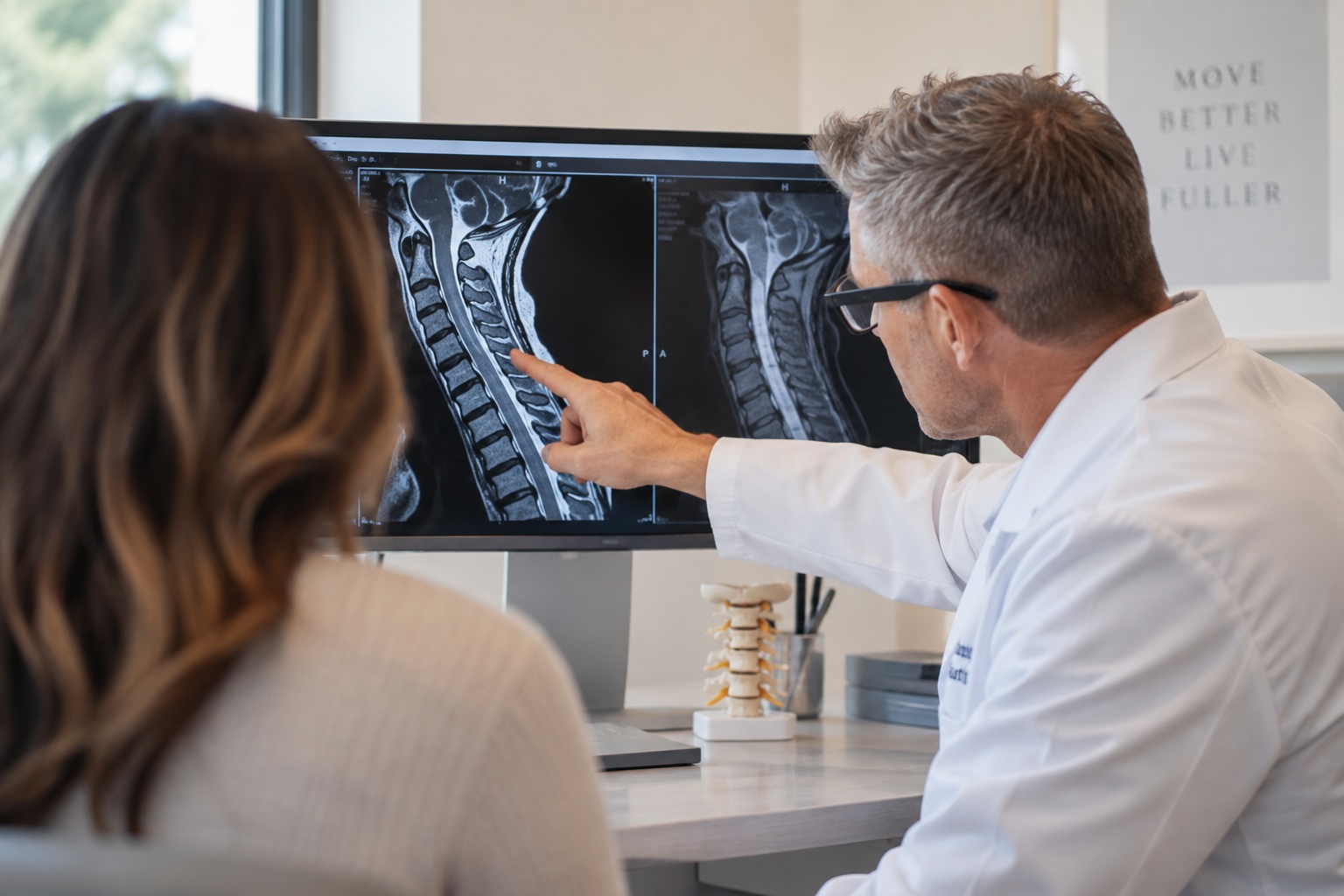



If you've had an MRI of your spine, you may have seen the terms "bulging disc" or "herniated disc" in your results. Although they sound similar, they describe two different changes to the discs in your spine.
Both conditions can cause back or neck pain, but they don't always lead to symptoms. Understanding the difference can help you make sense of your diagnosis and determine whether treatment is necessary.
What Is the Difference Between a Bulging Disc and a Herniated Disc?
The main difference between a bulging disc and a herniated disc is how the disc extends beyond its normal position.
Spinal discs sit between the vertebrae and act as cushions that absorb shock and allow the spine to move. Each disc has a tough outer layer called the annulus fibrosus and a softer, gel-like center called the nucleus pulposus.
Here's how the two conditions differ:
- Bulging disc: A broad portion of the disc extends beyond its normal boundaries. The disc may become flatter or spread outward, often due to age-related degeneration.
- Herniated disc: A more localized portion of disc material pushes beyond the disc's normal boundaries. This may occur when the outer layers weaken or tear, allowing material from inside the disc to move outward.
Both can affect the cervical (neck) or lumbar (lower back) spine. However, having either condition does not necessarily mean you will experience pain or require treatment.
Is a Herniated Disc Worse Than a Bulging Disc?
Not necessarily. Although a herniated disc may sound more serious, the type of disc abnormality alone does not determine how severe the condition is.
For example, a small herniated disc pressing directly on a nerve may cause significant pain, numbness, or weakness. Meanwhile, a larger bulging disc may cause no symptoms if it isn't affecting nearby nerves.
Several factors influence how serious a disc problem may be:
- Location: A disc pressing on a nerve or the spinal cord may cause more significant symptoms.
- Nerve compression: The amount and location of pressure on nearby nerves can affect pain and function.
- Inflammation: Disc material can irritate surrounding nerves, even without substantial compression.
- Neurological symptoms: Muscle weakness, numbness, and changes in coordination may indicate more significant nerve involvement.
In other words, the severity of a disc problem depends more on how it affects the surrounding structures and your daily function than whether it is called a bulge or herniation.
Do Bulging and Herniated Discs Cause Different Symptoms?
Bulging and herniated discs can produce very similar symptoms. In fact, it's often impossible to tell them apart based on symptoms alone.
Common symptoms may include:
- Neck or lower back pain
- Pain radiating into the shoulder, arm, buttock, or leg
- Numbness or tingling in the arms, hands, legs, or feet
- Muscle weakness
- Pain that worsens with certain movements or positions
The location of the affected disc often determines where symptoms appear.
For example, a disc problem in the cervical spine may irritate nerves traveling into the shoulders and arms. In the lumbar spine, nerve irritation may cause sciatica, which typically produces pain traveling from the lower back or buttock down the leg.
It's also common for people to have disc bulges or herniations without experiencing any symptoms. These findings become more common with age and may be discovered during imaging performed for unrelated reasons.
How Can You Tell if a Disc Is Bulging or Herniated?
A physical examination can help identify whether your symptoms suggest a disc-related problem, but imaging is usually needed to distinguish a bulging disc from a herniated disc.
A spine specialist may use several methods to evaluate your condition:
- Physical examination: Tests muscle strength, reflexes, sensation, and movements that may reproduce symptoms.
- MRI: Provides detailed images of the spinal discs, nerves, and surrounding tissues to identify disc bulges, herniations, and nerve compression.
- Additional testing: CT scans or nerve studies may be recommended in certain situations when more information is needed.
One important point is that an abnormal MRI does not automatically explain your pain. A disc bulge or herniation may appear on imaging without being responsible for your symptoms.
That's why a spine specialist considers your medical history, symptoms, physical examination, and imaging together before recommending treatment.
Does a Bulging or Herniated Disc Require Surgery?
Most people with symptomatic bulging or herniated discs do not need surgery. Many improve with conservative treatment, especially when there is no significant neurological impairment.
Depending on the symptoms, treatment may include:
- Physical therapy to improve strength, mobility, and spinal support
- Activity modifications to reduce movements that aggravate symptoms
- Anti-inflammatory or other appropriate pain medications
- Epidural steroid injections for certain cases involving nerve inflammation
Surgery may be considered when symptoms remain disabling despite appropriate treatment or when there is significant or worsening neurological impairment.
The decision is based on the patient's symptoms, examination findings, imaging results, and overall health rather than the disc diagnosis alone.
Do the Surgical Options Differ for a Bulging Disc vs Herniated Disc?
If surgery becomes necessary, the procedure depends more on where the disc is located and how it affects nearby nerves than whether it is bulging or herniated.
For a herniated disc, a surgeon may perform a microdiscectomy to remove the portion of disc pressing on a nerve, particularly in the lower back.
For a bulging disc, surgery is less commonly needed. If the bulge contributes to significant nerve compression or spinal stenosis, a decompression procedure may help create more space for the affected nerves.
In certain cases, particularly involving the cervical spine or spinal instability, procedures such as artificial disc replacement or spinal fusion may be considered for either condition.
The goal is to address the source of the symptoms while preserving as much normal spinal function as possible.
When Should You See a Spine Specialist?
An occasional episode of back or neck discomfort isn't necessarily a sign of a serious disc problem. However, persistent symptoms deserve attention, particularly when they begin affecting your daily activities.
You may want to get in touch with a spine specialist if you experience:
- Back or neck pain that isn't improving
- Pain traveling into your arms or legs
- Persistent numbness or tingling
- Muscle weakness or difficulty performing normal activities
- Symptoms that continue despite conservative treatment
New or worsening weakness should be evaluated promptly. Sudden loss of bladder or bowel control, numbness around the groin or saddle area, or rapidly progressing neurological symptoms require emergency medical attention.
Get Answers About Your Disc Condition
Whether you have a bulging disc or a herniated disc, the right treatment starts with understanding what's causing your symptoms.
Dr. Jeremy Smith is a board-certified orthopaedic spine surgeon who provides comprehensive evaluations and personalized treatment options for spinal conditions. If you're experiencing persistent neck or back pain, contact his Orange or Irvine office to schedule a consultation.