


Spinal fusion can be the right procedure for patients with instability, deformity, severe arthritis, nerve compression, or painful degenerative changes. The goal is to stabilize a problem area and reduce motion at a painful or unstable spinal segment.
Because the spine works as a connected system, the levels above or below a fusion may take on more stress over time. In some patients, those nearby levels can begin to break down and cause new symptoms. This is known as adjacent segment disease.
Adjacent segment disease does not always mean the original fusion failed. It often means another area of the spine has changed and should be evaluated carefully.
What Is Adjacent Segment Disease?
Adjacent segment disease, often called ASD, happens when a spinal level next to a previous fusion develops degenerative changes that become symptomatic.
This can involve several different problems, including:
- Disc degeneration
- Spinal stenosis
- Herniated disc
- Facet joint arthritis
- Instability
- Nerve compression
- Bone spurs
Some patients may have changes near a fusion that show up on an X-ray or MRI but do not cause pain. This is often referred to as adjacent segment degeneration.
Adjacent segment disease is different because the changes are now causing symptoms, such as pain, numbness, tingling, weakness, or trouble with normal activities.
Because of this, treatment should not be based on imaging alone. A spine surgeon will look at the patient’s symptoms, exam findings, imaging, and daily limitations before recommending the next step.
Why Can It Happen After Spinal Fusion?
The spine is designed to move through multiple segments. When one or more segments are fused, that area no longer moves the same way. As a result, the levels above and below the fusion may take on more stress.
Adjacent segment disease usually develops from a combination of factors, not one single cause. These may include:
- Natural aging of the discs and joints
- Degeneration that was already present near the fusion
- The number of spinal levels fused
- Spinal alignment after surgery
- Arthritis in the facet joints
- Smoking, weight, bone quality, and activity level
Sometimes, the adjacent level was already starting to wear down before the original fusion. It may not have needed treatment at the time, but it can become more symptomatic years later.
Common Symptoms of Adjacent Segment Disease
Symptoms depend on where the prior fusion was performed and which nearby level is affected. Adjacent segment disease can happen in the neck, mid back, or lower back, although it is most often discussed after cervical or lumbar fusion.
After a neck fusion, symptoms may include:
- Neck pain or stiffness
- Pain that travels into the shoulder, arm, or hand
- Numbness or tingling in the arm or fingers
- Hand weakness
- Trouble with coordination
- Balance changes in more advanced cases
After a lower back fusion, symptoms may include:
- New low back pain above or below the fusion
- Pain into the buttock, hip, thigh, calf, or foot
- Sciatica-like symptoms
- Numbness or tingling in the leg or foot
- Leg weakness
- Trouble standing or walking for long periods
- Relief when sitting or leaning forward, especially if stenosis is involved
Some patients notice symptoms slowly. Others feel like the pain returned after doing well for months or years. The timing can vary widely.
New pain after spinal fusion should not be ignored, but it should also not be assumed to be adjacent segment disease right away. Hip arthritis, sacroiliac joint pain, muscle strain, neuropathy, and other spine conditions can create similar symptoms.
How Adjacent Segment Disease Is Diagnosed
A proper diagnosis starts with understanding the full story. A spine surgeon will usually ask about the original surgery, when symptoms returned, where the pain travels, what makes it better or worse, and whether there is any weakness or numbness.
The evaluation may include:
- A physical exam
- A neurologic exam
- Review of prior surgery records, if available
- X-rays to look at alignment and hardware
- Flexion-extension X-rays to check for abnormal motion
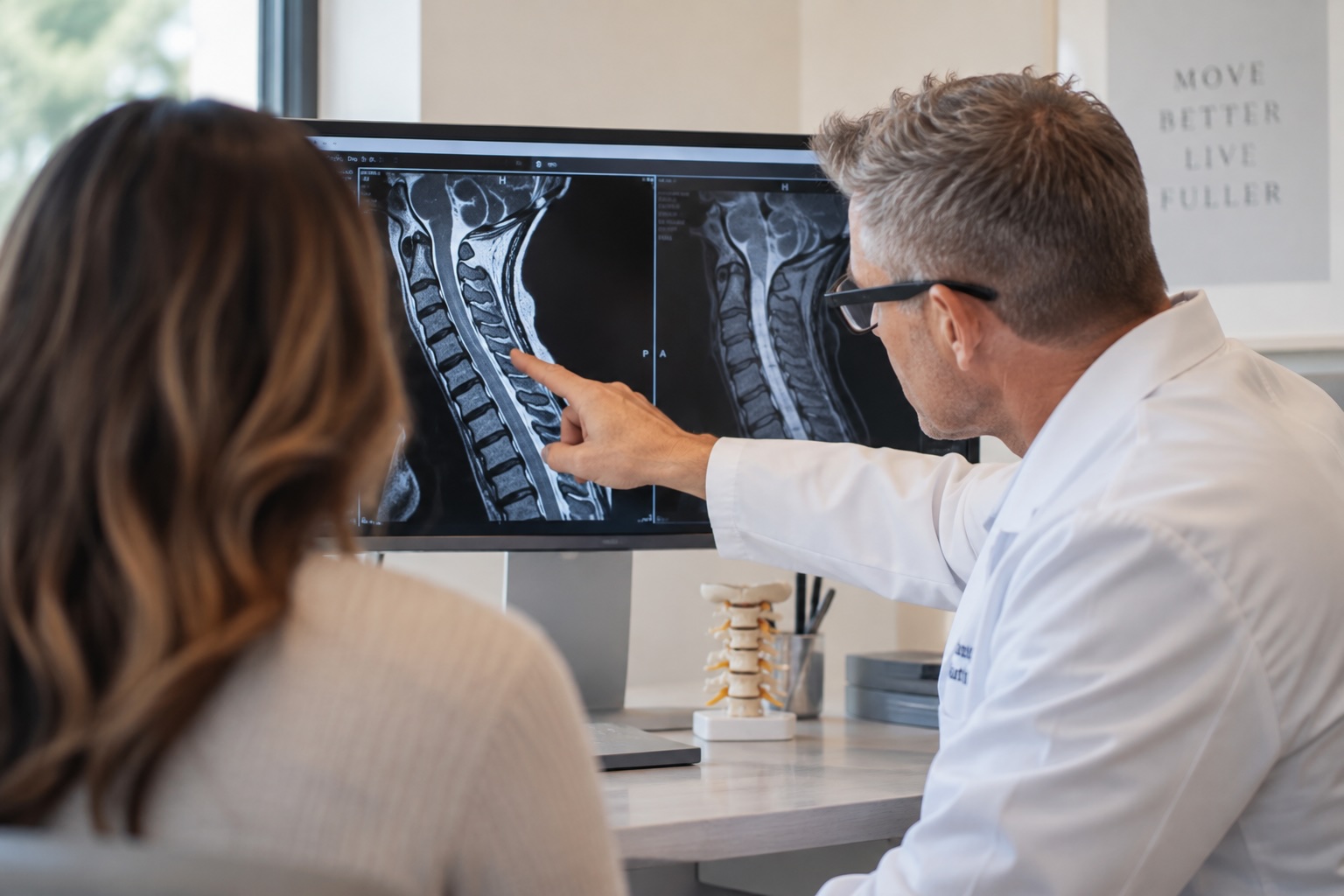
- MRI to evaluate discs, nerves, stenosis, and soft tissue
- CT scan in select cases to look more closely at bone or the prior fusion
The goal is to determine whether the adjacent spinal level is truly the source of the symptoms. This step is important because treating the wrong pain generator can lead to poor results.
Non-Surgical Treatment Options for Adjacent Segment Disease
Treatment depends on the severity of symptoms, the amount of nerve compression, the stability of the spine, and how much the condition is affecting quality of life.
Many patients do not need another surgery right away. If symptoms are mild to moderate and there is no major weakness or instability, conservative care may be recommended first.
Non-surgical treatment may include:
- Physical therapy
- Anti-inflammatory medication when appropriate
- Activity modification
- Core strengthening
- Posture and body mechanics training
- Image-guided injections
- Nerve pain medication in select cases
- Monitoring symptoms over time
The goal of non-surgical care is to reduce inflammation, improve strength and mobility, and help the patient stay active safely.
Surgical Treatment Options for Adjacent Segment Disease
Surgery may be considered when symptoms are severe, worsening, or not improving with conservative treatment. It may also be recommended sooner if there is significant nerve compression, weakness, instability, or difficulty walking.
Surgical options may include decompression to relieve pressure on the nerves, extension of the fusion to include the affected level, or revision surgery if there are issues with alignment, hardware, or the prior fusion. In select cases, motion-preserving options may also be discussed, depending on the patient’s anatomy and surgical history.
There is no single procedure that works for every case. The right treatment depends on the patient’s symptoms, imaging, prior surgery, spinal alignment, and long-term goals.
When to See a Spine Surgeon
It is worth seeing a spine surgeon if you have had a prior fusion and are now dealing with new or worsening symptoms.
You should consider an evaluation if you notice:
- Pain that travels into the arm or leg
- Numbness or tingling
- New weakness
- Trouble standing or walking
- Loss of coordination
- Balance problems
- Pain that interferes with sleep, work, or daily activities
- Symptoms that are not improving with conservative care
Early evaluation can help determine what is actually causing the symptoms. In some cases, treatment may be simple and non-surgical. In others, waiting too long can allow nerve compression or instability to progress.
Talk With Dr. Jeremy Smith About Symptoms After Spinal Fusion
If you had a prior spinal fusion and are now experiencing new neck, back, arm, or leg symptoms, Dr. Jeremy Smith can help determine whether adjacent segment disease or another spine condition may be involved.
Dr. Smith is an orthopaedic spine surgeon in Orange, CA who treats complex cervical, thoracic, and lumbar spine conditions, including revision cases after prior spine surgery. To schedule an evaluation, contact Dr. Smith’s office today.
Frequently Asked Questions
Is adjacent segment disease the same as a failed fusion?
No. Adjacent segment disease does not automatically mean the original fusion failed. It means a nearby spinal level has developed symptomatic degeneration or nerve compression.
How long after spinal fusion can adjacent segment disease develop?
Adjacent segment disease may develop months or years after surgery. The timing depends on the patient’s anatomy, age, spinal alignment, activity level, and whether nearby levels were already degenerating.
Does adjacent segment disease always require surgery?
No. Many patients start with non-surgical care, especially if symptoms are manageable and there is no major weakness or instability. Surgery may be considered if symptoms are severe, progressive, or not improving with conservative treatment.
Can adjacent segment disease happen after neck or lower back fusion?
Yes. It can happen after cervical or lumbar fusion. In the neck, it may cause symptoms in the shoulders, arms, or hands. In the lower back, it may cause pain, numbness, tingling, or weakness into the hips, legs, or feet.